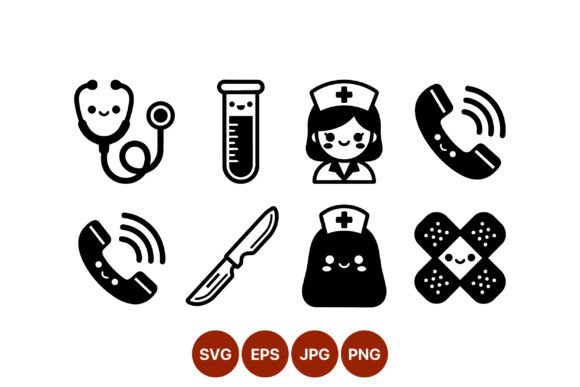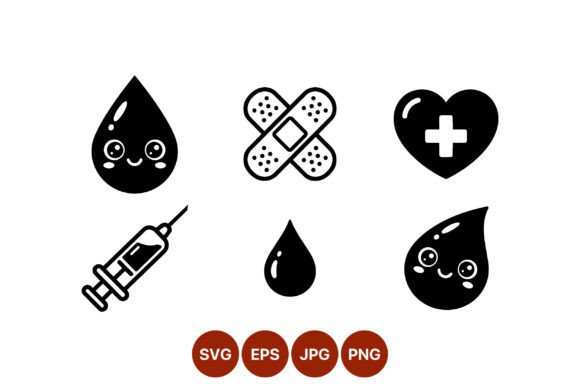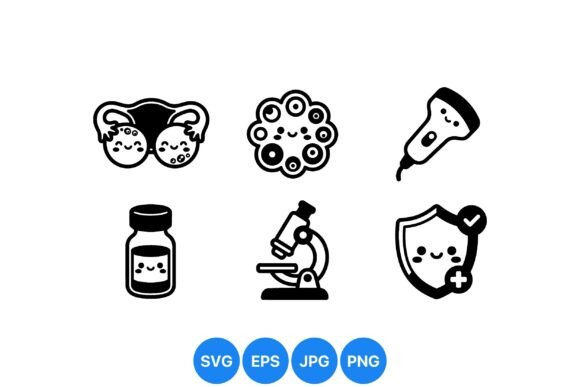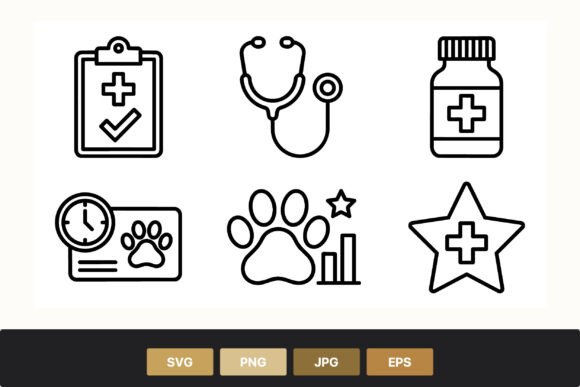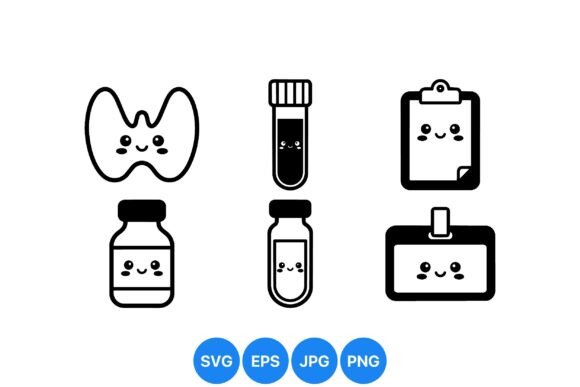
Cute Medical Icons Clipart Set
A Designer’s First Look: Playful, Precise, and Purpose-Built
When I opened the Cute Medical Icons Clipart Set, my first thought wasn’t “Oh, another clipart pack.” It was, “This feels like a conversation starter.” The thyroid gland isn’t anatomically rigid—it’s softly rounded, with gentle curves and a subtle nod to its butterfly shape. The test tubes wear cheerful, minimalist smiles. The vial has just enough tilt to feel dynamic; the clipboard holds clean negative space; the badge reads like a tiny, confident ID tag. All in crisp black-and-white vector style—no gradients, no shadows, no visual noise. That simplicity is intentional—and it’s exactly what makes this set quietly powerful for embroidery.
Why This Set Fits Real Embroidery Projects (Not Just Screens)
I recently sketched out a custom embroidered tote bag for a local pediatric clinic’s staff appreciation day. They wanted something warm but professional—no stethoscopes or red crosses, nothing overly clinical. The Cute Medical Icons Clipart Set landed perfectly: I paired the smiling test tube with the badge icon on a light gray cotton canvas. Why it worked? Because each icon has generous interior spacing, open contours, and consistent stroke weight—traits that translate cleanly into satin stitch and fill stitch without crowding or bleeding.
It’s equally at home on baby onesies (the thyroid icon stitched beautifully on 100% cotton interlock with tear-away stabilizer), kitchen tea towels (where the clipboard icon held crisp definition across repeated washes), and embroidered patches for nurse-led craft fairs. As an Illustrations asset, it’s not just decorative—it carries tone. That friendliness builds trust. A customer seeing this on a boutique apron doesn’t think “generic clipart”—they think “thoughtful, handmade, made for *them*.”
Where It Shines—and Where You’ll Want to Pause
The Cute Medical Icons Clipart Set excels on stable, medium-weight fabrics: denim jackets, structured tote bags, twill caps, and pillow covers. On sweatshirts? Yes—but use cutaway stabilizer underneath to prevent puckering around the vial’s narrow neck or the badge’s sharp corners. On stretchy fabric like ribbed knit tees? Proceed with caution: simplify stitching paths or isolate one icon at a time instead of grouping all five.
For small hoop sizes (under 4×4 inches), prioritize single icons—the test tube or badge scale down cleanly; the thyroid gland holds up well at 2.5" wide, but avoid shrinking the full set together. Tiny lettering isn’t present here (a strength, honestly), so no worries about unreadable text on dark fabric. That said, always test thread color contrast: black thread on navy denim reads clearly, but white thread on heather grey may need a second pass or underlay stitch for opacity.
Design Assets That Support, Not Complicate, Your Workflow
As a working embroidery designer, I value assets that don’t ask me to fix them before stitching. The Cute Medical Icons Clipart Set delivers that. Its vector foundation means clean edges at any size—no pixelation when scaling for a large tote bag design or a delicate baby cap. No overlapping paths. No hidden layers. That clarity saves real time when prepping a commercial embroidery file or building a printable mockup for your Etsy listing.
It also supports brand consistency. If you sell personalized gifts for healthcare workers, this set gives you a cohesive visual language—playful but respectful, modern but approachable. Customers recognize it across products: a patch on a lab coat, a subtle vial icon on a holiday mug sleeve, the clipboard on a nurse’s embroidered pillow cover. That repetition builds recognition without feeling repetitive.
Practical Notes Every Embroiderer Should Keep Handy
- Always test on scrap fabric first—especially with textured weaves or dark backgrounds. What looks balanced on screen may shift in stitch density.
- Review stitch density before finalizing. These icons are low-to-mid density by nature, but check where fills meet outlines—some machines benefit from slight underlay on curved elements like the thyroid.
- Confirm hoop size compatibility before digitizing. While the set is vector-based, your machine’s max hoop limits will determine how many icons you can group safely.
- Inspect small details at actual stitch size—not zoomed in on screen. The smile on the test tube is charming, but ensure it’s legible at 1.2" tall on a child’s onesie.
- Test black-and-white mockups on both light and dark fabric swatches. Contrast drives perception—and this set relies on it.
- Use proper stabilizer: medium-weight cutaway for knits, tear-away for stable wovens, and fusible for lightweight linens.
- Check licensing before selling finished items or bundling as part of a digital product. Since this is a Graphics download, confirm whether commercial use—including resale of embroidered products—is explicitly permitted.
Final Thought: Charm With Craftsmanship
The Cute Medical Icons Clipart Set doesn’t try to be everything. It’s not a medical textbook illustration. It’s not photorealistic. It’s not overloaded with detail. And that’s why it works so well in real-world embroidery: it leaves room for your craftsmanship to shine. When stitched on a linen pillow cover for a new endocrinology fellow’s baby shower, it felt personal—not mass-produced. When used as a subtle embroidered patch on a boutique apron for a wellness café, it added warmth without shouting.
For Etsy sellers, craft fair vendors, and small shop owners, this set is more than decoration. It’s a quiet signal: “We see you. We respect your work. And we made something just right for it.” That kind of resonance—earned through thoughtful design, not marketing hype—is what turns a simple embroidery project into a meaningful finished product.